What We Don't See Behind The Uniform
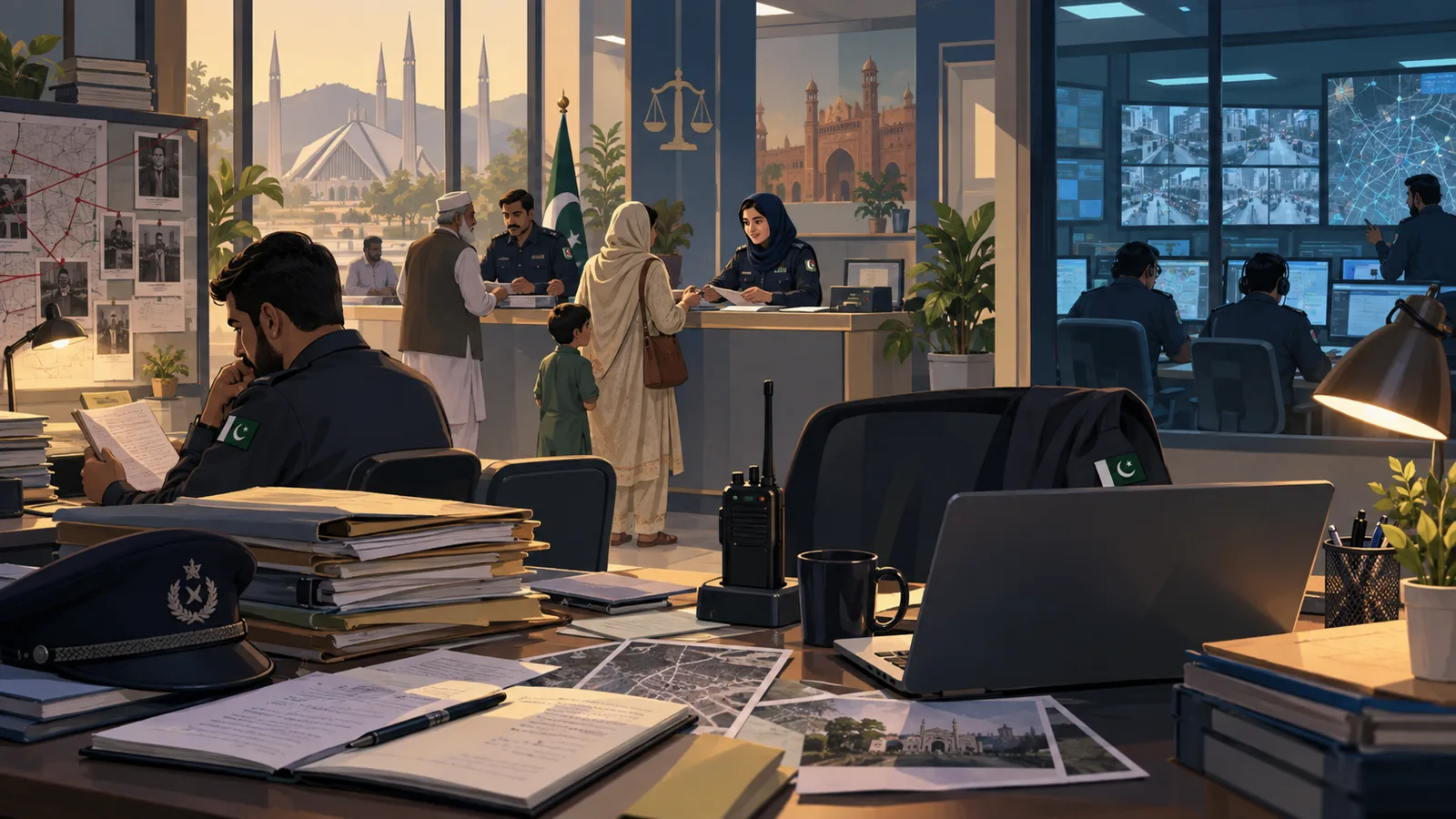
Based on my police internship in Chakwal, this piece reflects on what I learned about the less visible side of policing, from investigations and digital systems to Safe City and public communication. It explores how understanding the process behind the uniform can lead to fairer expectations, better criticism, and trust.
What We Don’t See Behind The Uniform
By: Ali Abdullah
I did my internship with the police in Chakwal, Punjab, but before I started my internship, I had many of the same assumptions and understanding of the police that many other people have, which are mostly negative without really understanding why. I think it was more about what the general perception about police was than actual facts. I used to believe, like many others, that police work was much simpler. Someone reports, the police go to the scene, ask around and arrest whoever they think is the culprit and move on. If police do not arrive at the scene quickly enough, people start to think that they are not doing the work and are lazy. But in reality, my internship showed me how different the reality is from people’s perception.
One of the main things I learned was that a complaint can have multiple stories and sides. It is not always simple because both parties can call the police and report their own side of the story while ignoring the other side. So investigators are taught the principle that they should consider different versions of an incident instead of jumping to an obvious conclusion for or against one side. Most importantly, to understand the situation, they need to hear all sides, check injuries and other evidence and talk to witnesses. So a complaint is the starting line to finding the truth and not always the final truth. However, this does not necessarily mean that every delay is justified; it just gives the leniency to the fact that police have to work with more uncertainty while each citizen usually knows their own side of the story.
During my time in the internship across different places, I saw many less visible workings such as records, legal and administrative work, uniforms, equipment, accounts, complaint handling, vehicles and other logistical support. Police Lines and the police station made me realize that every police officer has an entire system working behind them to keep them working in the field; each one depends on various functions such as vehicles, uniforms, documentation, records, equipment and other support functions. It is not always about dramatic arrests or bullets flying everywhere. The people I interacted with were mostly nice and approachable and some even used humor to liven up the place. They made the institution that I was nervous about going into for the first time less distant and more human.
I was introduced to various technologies that were being used daily and it surprised me. Among many, a few of them were e-Gadget, CDR analysis, geofencing and the Complaint Management System. I came to like e-Gadget more than others because it connected police to normal mobile shops and their market. This system allows registered shopkeepers to check if the phone that is being sold to them is registered as a stolen or lost device. And it notifies the police about the stolen device and the store it is being checked in. CDR analytics and geofencing are among other things that help police in their investigation on the communications side. While CMS showed me how the complaints and progress of those complaints are all registered and get an e-tag. I realized that policing happens not just on streets, but a growing part of it also happens through databases, digital records, phones, screens and technical analysis.
The moment I entered Safe City, I was astounded; it was the most visually striking part of my internship. I, like many others, never thought of who was actually monitoring all those cameras on the roads. This organization's entire work was surveillance and helping the investigators in their work. Punjab Police, CCD and Traffic Police representatives were working in the same environment. I saw them monitor an Imam Bargah during a gathering and a juloos (procession) with body cams and temporary 4G cameras. They are expanding their coverage even more with temporary and permanent cameras in the future. However, this situation in Safe City also made me realize that the amazement I felt here was not something that I felt as much in some other places. Some work was highly digital and modern, while other work was still being done on paper with no digital form. Some departments can work so fast that the only thing that would slow them down would be a slower department. The public sees a result and judges whole institutions without seeing the administrative, technical and investigative work people have put in to produce that result.
Watching police work from the inside gave me more information to work with in my decision-making and thought process, but it does not make every concern of the public wrong. They are right to think that when they call, they should be reasonably talked to, their complaints heard and matters settled. But it also means that if the public understands the working of the police, their first interpretation won't be that the police are lazy. Technology can help so much, but it also depends on the humans who are using it, procedures being followed and information being acted upon. It builds the confidence of the public. People can judge fairly when they know how the institution works.
One of the biggest takeaways was the fact that not many people get the information about anything that is being implemented by the institution. The negative news spreads much quicker, while the positive news either spreads very slowly or stalls. People have heard about Safe City but do not know what it actually does. Many people do not know what e-Gadget does or what CMS is. The public is not always aware of the new systems that are being implemented, so just because a system is put in place does not mean that it is going to be common knowledge. The old image will only disappear when improvements are visible to the common people.
My internship helped me understand more about the police and the institution overall, so I can judge fairly instead of taking others' word for it. I understand now that behind every officer there are multiple departments working, technology being used, vehicles and equipment. Police still have an obligation to improve wherever they can and wherever it is necessary. They need to communicate their workings with the public more efficiently. The public can criticize genuine problems and trust is built when they are more knowledgeable about the institution they are talking about. However, it does not mean that they need to be unconditionally supportive.